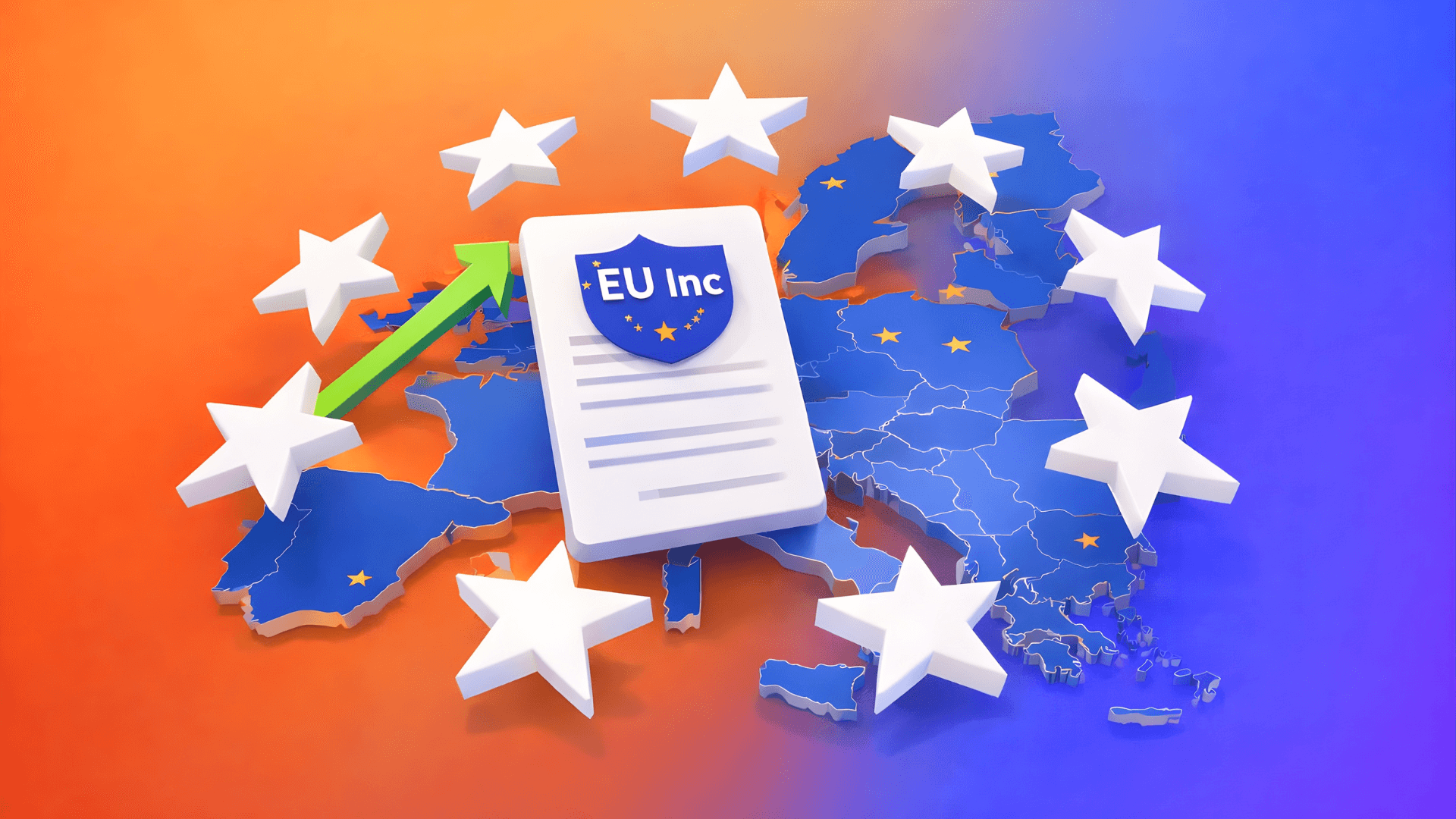
the28thregime.eu reports that the Council Working Party on Company Law held Session 4 on 6 and 7 May 2026, the JURI Committee heard Commissioner McGrath on 4 and 5 May, and the 7th LawFin Workshop convened on 7 May to discuss venture-capital contracting, insolvency design, and political adoption of the proposal.
Minister for Enterprise, Tourism and Employment Peter Burke secures government approval for a Single Market Taskforce and Single Market Office to coordinate Irish engagement on EU files, including 28th regime negotiations.
Business Insider's Gruenderszene unpacks the EU Inc. proposal for founders with two startup lawyers, comparing the proposed Delaware-style vehicle with the German GmbH: 48-hour digital registration, no minimum capital but balance-sheet and solvency tests before dividends, VC-friendly multiple share classes, fully digital notary-less transfers and an EU-wide ESOP regime with tax deferred to sale. The piece criticises remaining national-law carve-outs for tax, labour and co-determination but concludes EU Inc. is a genuine opportunity for Europe if implementation succeeds, with practical availability unlikely before 2028.
Italian Minister of Enterprises and Made in Italy Adolfo Urso met EU Commissioner for Startups Ekaterina Zaharieva in Bologna, with talks centered on the reform of the single European corporate framework (EU Inc., the 28th regime) and the Scaleup Europe Fund. The meeting signals direct Italian government engagement with the trilogue-stage file.
Top German corporate law firm Noerr (Tibor Fedke and Felix Blobel) calls the EU Inc. proposal the most consequential attempt yet to create a uniform, digitally incorporable capital company for the single market and the first credible competitor to Germany's GmbH. The analysis details the fast-track central EU registration, balance-sheet/solvency-based capital regime, dual-class shares and EU-wide ESOP, while flagging significant risks: German co-determination triggering constitutional concerns, notary-fee incompatibility with the EUR 100 cap, Article 114 competence questions and dilution risk in the looming trilogue.
the28thregime.eu publishes an editorial assessment of the 7 May ECGI, Bocconi, and LawFin academic workshop on the EU Inc. proposal, identifying four problem areas: market fragmentation in scale-up financing, gaps in venture-capital contracting, insufficient insolvency-restructuring pathways, and uncertain political coalition-building.
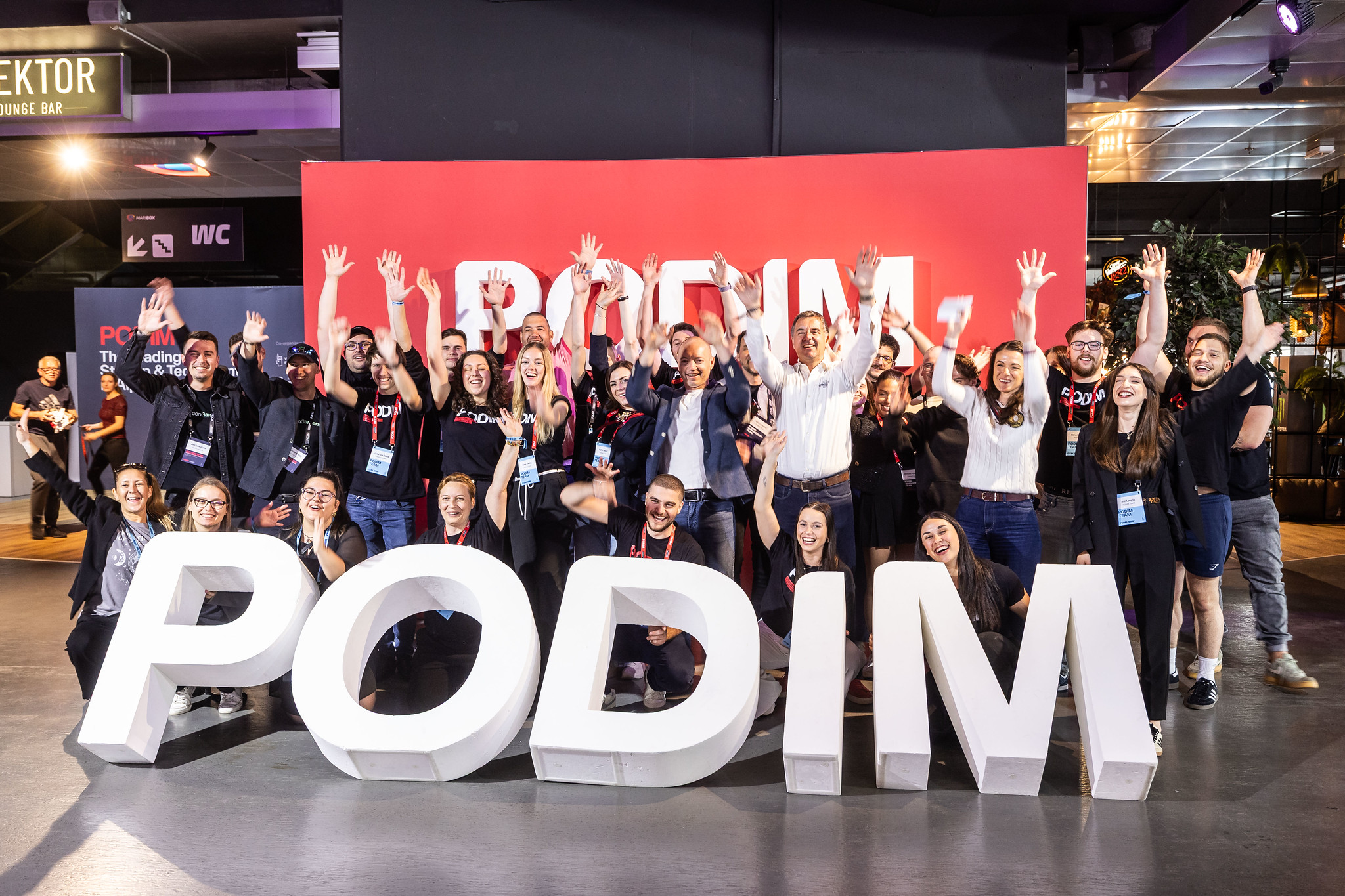
Preview of Podim 2026 (11-13 May, Maribor). Confirms the EU-INC initiative is among the bodies shaping Europe's scale-up response and that EU-INC co-creator Robin Wauters will speak alongside the European Innovation Council and the Commission's startup/scaleup task force.
Whitney Moore corporate partner Brendan Ringrose and associate Erta Kalemi walk through the March 2026 EU Inc regulation, explaining that it will sit alongside Irish Companies Act 2014 entities as an optional pan-EU form aimed at reducing fragmentation for scaling businesses.
Computer Sweden (IDG) explains how the proposed EU Inc. 28th regime is intended to simplify operations for European tech startups by enabling a single registration and unified rules across all member states. The piece highlights the challenges of navigating 27 different national systems and complex employee stock-option rules that often push ambitious EU founders toward the United States.
Mondaq republishes the Michael Kyprianou note for an international legal-practitioner audience, giving the Cyprus law-firm view on EU Inc. additional reach. It frames the 28th regime as an optional EU-wide vehicle that will sit alongside Cyprus's Cap. 113 companies regime rather than displace it, and discusses what is still uncertain pending trilogue.
Silicon Republic interviews Dorothy Hargaden of Dentons on the EU Inc proposal. She argues it combines familiar legal building blocks with new portability and digital-first registration, but notes Irish founders already benefit from comparable speed via the CRO and that national tax and employment rules remain fragmented.
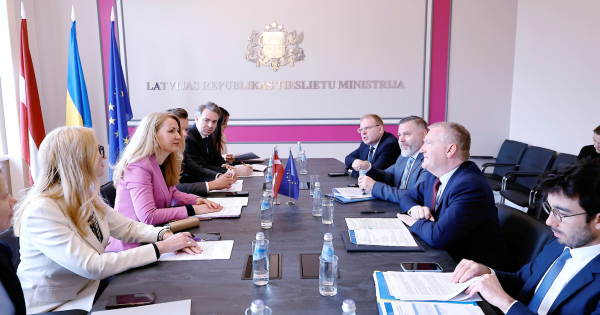
Official Latvian Ministry of Justice readout of the 30 April 2026 meeting between Justice Minister Inese Lībiņa-Egnere and EU Justice Commissioner Michael McGrath in Riga. The minister welcomed the EU Inc. / '28th regime' initiative as a way to help Latvian companies expand into other member states, while warning the framework must not create parallel registration systems that duplicate Latvia's already digitised SIA registration.
LV portāls (the state legal-information portal) carries the Ministry of Justice's release on Inese Lībiņa-Egnere's meeting with Michael McGrath. The piece positively frames the 28th regime / EU Inc. as a digital, cross-border company form that could strengthen both Latvia's and the EU's competitiveness, and quotes the minister urging the Commission to avoid duplicating existing national registration regimes.
Nigel Caruana of the Malta Business Bureau argues that the Commission's EU Inc proposal of 18 March 2026 creates an optional 28th corporate form letting founders register a company digitally across the EU in under 48 hours for under EUR 100. He says Malta is well placed to benefit: companies incorporating as EU Inc in Malta keep their Maltese tax residence and treaty network while gaining single-market reach, though structural limits remain because national law fills gaps left by the regulation.
the28thregime.eu summarises the 21 April European Economic and Social Committee conference on EU Inc., reporting that debate has shifted from abstract principles to concrete design questions about collective rights, labour safeguards, and the separation of registered and operational seats.
Czech Radio's Radiožurnál interviews Tomáš Prouza, vice-president of the Czech Chamber of Commerce, who calls the 28th regime a 'clever excuse for not solving real problems' as firms would still face national tax rules and bureaucracy. He concedes that better employee stock options and easier liquidation under EU Inc. could still benefit Czech startups.
IVSZ, Hungary's IT and digital business association, welcomes EU Inc. but argues the draft falls short of a truly unified regime: enforcement still goes through national registries and courts, and tax remains fully national. The association calls for stronger harmonization of corporate law, tax coordination and a standardized dispute-resolution mechanism so the new form actually improves competitiveness for Hungarian startups and scaleups.
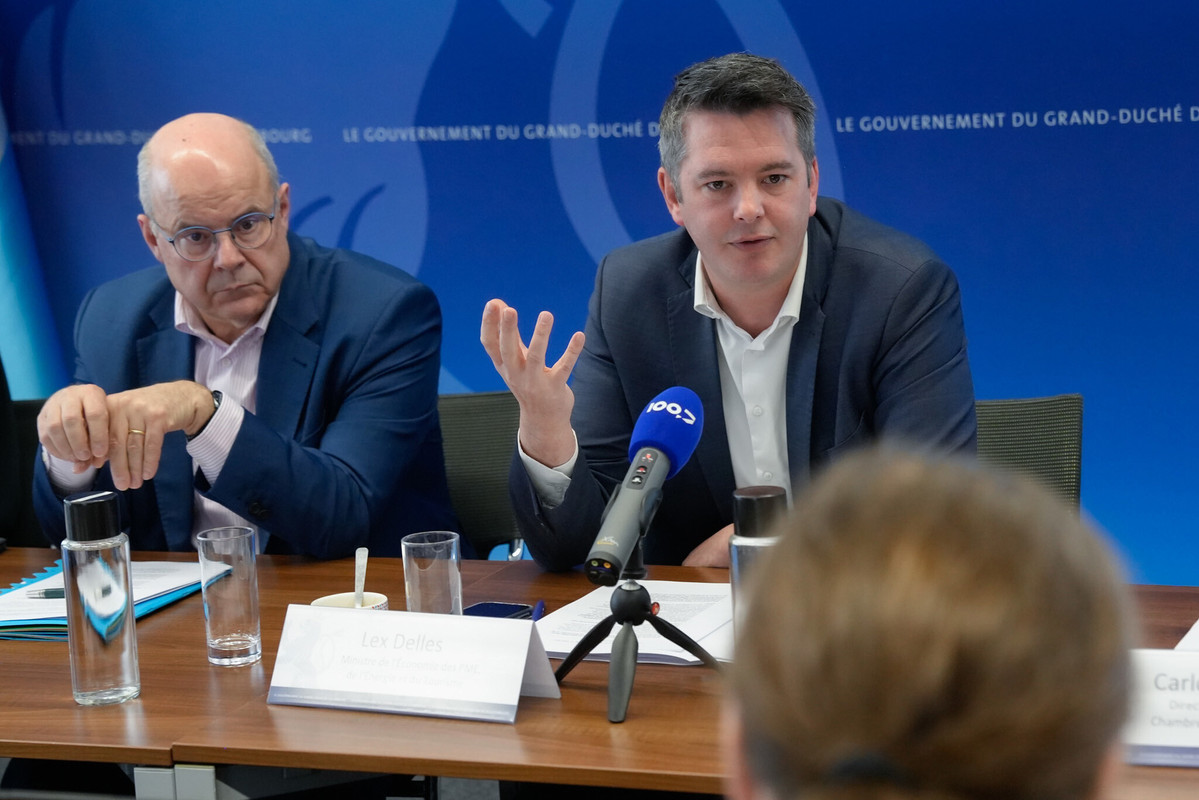
The Luxembourg government, via ministers Margue (Justice), Delles (Economy) and Spautz (Labour), publicly backs the EU Inc. / 28th regime project as a competitiveness lever while promising social safeguards on legal certainty, fraud and anti-money-laundering. The OGBL and LCGB unions reject the framework as deregulation that would weaken labour law, collective agreements and worker representation.
Der Standard reports on pushback from Austria's notarial chamber against EU Inc., which would remove the notarial requirement for share transfers and liquidations. Notaries argue the loss of mandatory intermediaries undermines legal certainty, while startup advocates counter that the proposal still doesn't go far enough toward harmonisation.
Council, Commission, and Parliament leaders endorse a joint roadmap to deliver the One Europe, One Market agenda by end-2027, with the 28th regime listed among the priority files for co-legislator agreement by end-2026.
A guest commentary in Der Standard argues that while the Commission's EU Inc. proposal is welcome, the current draft falls short on at least three points entrepreneurs care about. The author flags implementation around 2028 and pushes for amendments before the regime is adopted.
Belgian trade outlet AccountancyVandaag interviews tax lawyer Bram Cuppens (Sansen International) on what the EU Inc. means for accountants. The article notes the 48-hour digital incorporation but warns that tax and accounting compliance remain national, leaving complexity for advisers.
The Dutch House of Representatives (Tweede Kamer) publishes the cabinet's decision memo accompanying the BNC-fiche on the Commission's EU Inc. 28th-regime proposal. The document (2026D20087) marks the formal start of Dutch parliamentary scrutiny of the file ahead of the Council negotiations.
The European Economic and Social Committee Workers' Group convenes ETUC, S&D MEPs, the Spanish government, and the Commission to debate the EU Inc. proposal, with members warning of regulatory arbitrage, letterbox-company risk, and erosion of co-determination via the separation of registered and operational seats.
The Confederation of Industry of the Czech Republic (SP ČR) issues its position welcoming the European Commission's EU Inc. proposal as addressing fragmented national company laws and supporting startup growth across the EU. SP ČR flags concerns over investor protections and compatibility with digital business registers.
KPMG Avocats partners Jean-Jacques Daigre, Alain Couret and Clément Barrillon analyse the Commission’s EU Inc proposal through a French lens, arguing it is essentially a European clone of the French SAS with greater flexibility. They detail the unified 28th regime’s 48-hour digital incorporation, €100 fee and full corporate life-cycle rules.
Op-ed on LRT by Viktorija Jauniūtė, legal counsel at law firm Constat, analysing what the 28th regime would mean for Lithuanian companies. She covers SAFE-style financing, digital share transfers, central EU registry access and the open implementation questions around tax obligations and interaction with national law.
The European Parliament Liaison Office in Malta and FPEI are launching EU Unlocked, a three-session course in May 2026 to help Maltese entrepreneurs read EU regulation and identify business opportunities. The programme explicitly introduces participants to the proposed 28th regime as a new EU-wide legal framework aimed at simplifying operations for fast-growing companies.
The Malta Independent reports on the joint European Parliament Liaison Office and FPEI training programme EU Unlocked running across three Friday mornings in May 2026. Sessions cover legislative procedures, EU funding and the proposed 28th regime, a new EU-wide legal framework aimed at simplifying operations for fast-growing Maltese companies.
Maltese business outlet Succeed covers the upcoming EU Unlocked course, which will introduce local entrepreneurs to the proposed 28th regime as part of training on EU policy, funding and regulation. Participants are taught how to use emerging EU frameworks to strengthen and future-proof their businesses.
Official Swedish government fact memorandum from the Justice Department submitted to the Riksdag on the Commission's EU Inc. proposal (COM(2026) 321). Sweden welcomes the initiative as a step in strengthening EU competitiveness, but flags concerns about simplified insolvency rules and the inclusion of tax-related provisions in the regulation.
Markus Brueckner, Brussels representative of the German Federal Chamber of Notaries (Bundesnotarkammer), publishes a sharply critical analysis questioning the Commission's reliance on Article 114 TFEU as a legal basis and the proposal's abandonment of preventive controls such as mandatory notarial verification and identity checks. He warns the framework inadequately protects vulnerable parties, tax enforcement and anti-money-laundering, and concludes a workable 28th regime must combine digitalisation with continental Europe's preventive control mechanisms rather than copy Anglo-American post-dispute models.
EU-bureauet's Staffan Dahllöf takes a long-form look at the EU Inc. / 28th-regime proposal, weighing the Commission's growth promises (48-hour, sub-EUR 100 registration across the EU) against critics who fear regulatory arbitrage and wage dumping reminiscent of the 2004 Services Directive. The article maps the Danish positions ahead of the upcoming trilogue.
Pinsent Masons publishes an analysis describing how EU Inc. would create a digital, optional alternative to the GmbH, UG, and AG, with particular friction around notarial requirements and supervisory-board co-determination thresholds.
In a detailed analysis on the Hans-Boeckler-Stiftung co-determination portal, Daniel Hay and Sebastian Sick argue the Commission's 28th regime, unveiled on the 50th anniversary of Germany's Mitbestimmungsgesetz, would let companies bypass employee board representation; over 2.4 million German workers already lack co-determination protection via comparable loopholes such as the SE. They demand the EU Inc. be restricted to startups and scale-ups and contain binding co-determination safeguards at EU level.
Suomen Yrittajat explains the EU Inc. proposal to its small-business readership: an entirely digital pan-EU limited company that can be incorporated in 48 hours for under 100 euros, with no minimum capital. The article emphasises that the form is aimed primarily at growth-oriented businesses seeking cross-border financing.
Eubelius partners Alain Francois and Helen Moreels analyse the Commission's 18 March 2026 proposal for the EU Inc. The piece explains the digital-only formation principle, the absence of minimum capital, and how Belgian corporate law would apply as residual rules for an EU Inc. registered in Belgium.
Detailed legal analysis on Teisė profesionaliai authored by COBALT senior lawyer Dominykas Jončas and legal assistant Kristina Valkiūnaitė. It walks through the regulation's key features — 48-hour incorporation, EUR 100 cap, no minimum capital, full digitalisation, fast-track liquidation — and contrasts EU Inc. with Lithuania's UAB (EUR 1,000 minimum capital) and the older Societas Europaea.
Irish Legal News surveys what EU Inc. means for Irish-incorporated companies, noting that Ireland's English-language common-law regime makes it a natural beneficiary while flagging tax-residence and anti-shell concerns.
The Flemish Bar Association (Orde van Vlaamse Balies) flags the Commission's EU Inc. proposal and notes that the CCBE is closely monitoring trilogue developments. The piece raises concerns from a notarial and consumer-protection angle as the file moves into negotiation.
French trade union Force Ouvrière publishes a critical piece on the EU Inc proposal, arguing that the 28th regime’s harmonized rules risk letting companies bypass French labour law, collective bargaining agreements and social contributions. The union calls for stronger worker-protection safeguards before trilogue concludes.
Gomez-Acebo & Pombo academic adviser Reyes Pala analyses the EU Inc proposal of 18 March 2026, which creates a new European limited liability corporate form open to all commercial entities. Key features include zero minimum capital, shares without nominal value, multiple-voting rights, Commission-approved model bylaws and 48-hour online incorporation for under 100 euros.
The Slovak Ministry of Justice announces the start of national-level work on the European Commission's 18 March 2026 EU Inc. proposal, the so-called 28th regime. It invites lawyers, academics and business representatives to submit input by end of April 2026 (28.rezim@justice.sk) to help shape Slovakia's position on the new pan-EU limited-liability form (48-hour digital registration, max EUR 100, zero minimum capital).
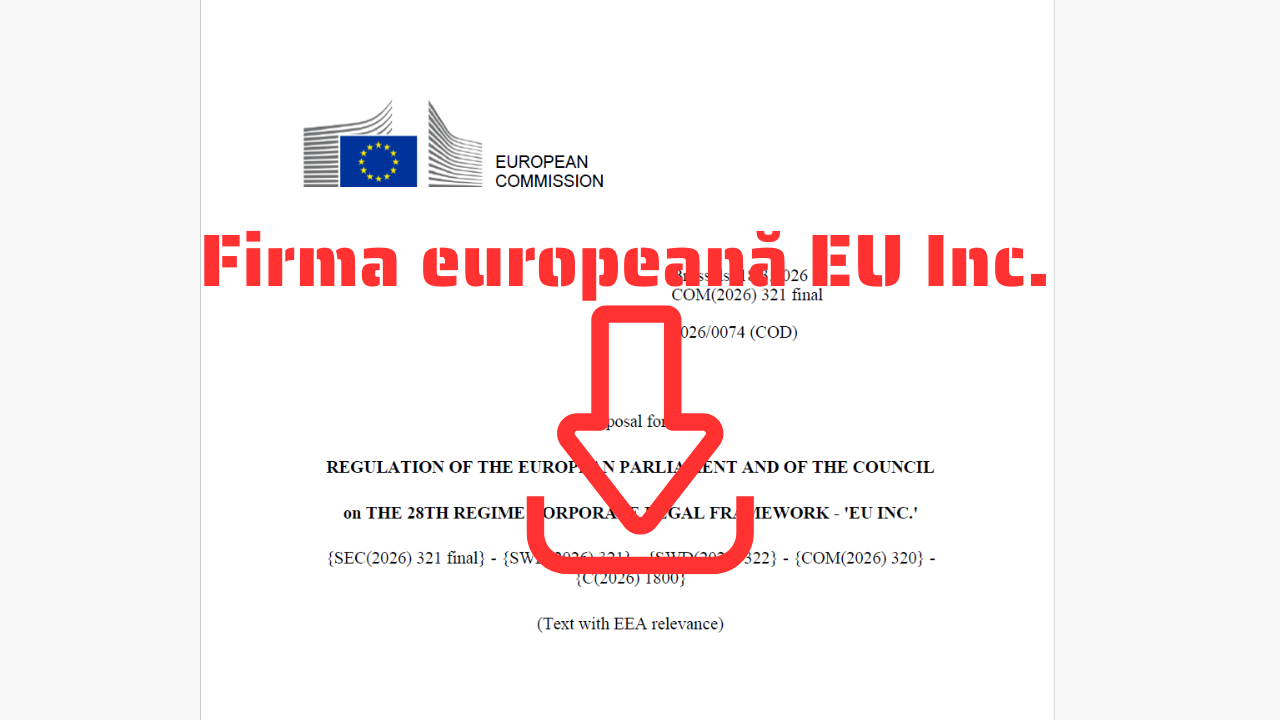
the28thregime.eu analyses the 134-page EU Inc. Regulation package, summarising key features including 48-hour digital registration, EUR 0 minimum capital, explicit SAFE financing provisions, and the constitutional choice to route dispute resolution through national courts.
Corporate Europe Observatory researcher Kenneth Haar argues in Arbejderen that the Commission's EU Inc. proposal (the former 28th regime) lacks safeguards against social dumping and could let firms registered in one member state bypass collective bargaining and board-representation rules in another. The piece urges Danish unions and politicians to push back during trilogue.
Accountancy Vanmorgen summarises Dutch press reactions to the EU Inc. proposal three weeks after publication. The Commission expects about 300,000 companies to adopt the form in the next decade, but unions fear shell-company use, notaries warn about weakened anti-money-laundering safeguards, and accountants question the unequal treatment of option-paid versus salary-paid workers; MEP Lara Wolters argues the text leans too heavily on the American model.
Follow-up briefing from the Estonian Chamber of Commerce and Industry detailing the 28th regime package beyond EU Inc itself: the European Business Wallet for cross-EU public-authority interactions, AI translation to cut language costs, simplified insolvency and capital access for fast-growing firms, cross-border remote work and digital social security, the HOT/BEFIT tax tracks, and proposed specialised EU Inc courts. The Commission still targets agreement by year-end 2026.
Romanian tax advisory firm Taxhouse analyses the EU Inc. proposal from a Romanian tax-and-corporate perspective, arguing that the main benefits are digitalisation and de-bureaucratisation rather than fiscal arbitrage, since taxation remains a member-state competence. The piece contrasts EU Inc. with the US Delaware model.
Dutch employers' federation VNO-NCW MKB-Nederland welcomes the Commission's EU Inc. proposal in principle, but flags concerns on anti-money-laundering safeguards, creditor protection, and the need for an optional uniform tax regime and central EU registry.
Tech-business outlet Breakit reports that the Commission has agreed to the tech community's demand for EU Inc., but that Swedish reality may temper enthusiasm. Lawyer Martin Folke (Bird & Bird) tells Dagens Industri that 48-hour registration clashes with current Bolagsverket processing times, and that EU Inc.'s removal of the SEK 25,000 capital requirement and allowance of voteless shares conflict with Swedish company law.
Nordic startup outlet Impact Loop reports that lawyer Martin Folke warns the EU Inc. framework's 48-hour incorporation and flexible share structures conflict with Swedish legislation. The proposal allows shares without voting rights and removes the capital requirement, features currently illegal in Sweden, and would require significant changes at the Swedish Companies Registration Office.
Spanish law firm Cuatrecasas reviews the European Commission's proposed Regulation for the 28th corporate regime. The analysis covers digital 48-hour incorporation, flexible capital, multilingual model bylaws, simplified share issuance, harmonised access to finance and employee stock-option schemes, with planned application from 2028.
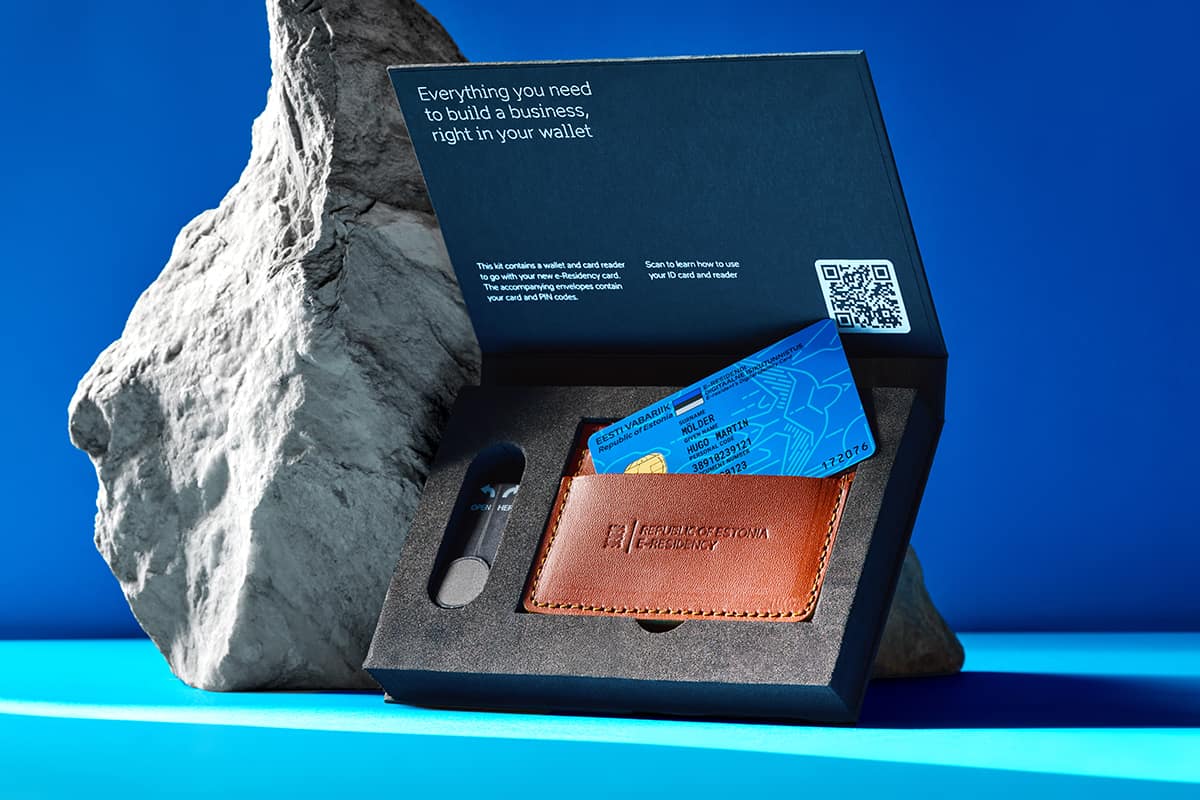
Estonia's e-Residency programme reports that German applications grew 49% in 2025 and that Germans founded a third more Estonian companies, framing the trend against the EU's emerging 28th regime / EU Inc initiative. Mats Kuuskemaa argues Estonia already delivers the core benefits the 28th regime aims to provide — instant, remote, fully digital incorporation — and positions e-Residency as the practical bridge for founders while the pan-EU framework is being negotiated.
A legal analysis by Dr. Ioana Olaru of the Romanian Notarial Institute, published on the Notar de Bucuresti site, on the Commission's EU Inc. proposal and the Parliament's January 2026 resolution. The piece examines the optional opt-in mechanism, 48-hour digital incorporation, integration with the BRIS register, and the notary's continued role in legal certainty under the new regime.
The Chamber of Commerce and Industry of Slovenia (GZS) welcomes the Commission's 18 March 2026 EU Inc proposal, praising its optional character, once-only digital registration, and flexible governance. GZS asks that insolvency law stay national, that labor rules be harmonized to remove cross-border barriers, and that transformation of existing companies into EU Inc be made simple and cost-free.
Slovak legal portal Najpravo analyses the European Commission's EU Inc. proposal as the central pillar of the 28th EU regime. It highlights how innovative firms today must navigate 27 national systems and more than 60 legal forms, and explains the EU Inc. benefits: registration within 48 hours for under EUR 100, no minimum capital, full digitalisation and a central EU registry auto-assigning tax and VAT IDs.
Czech law firm eLegal reviews the EU Inc. proposal as a new uniform optional corporate form aimed at modernising the European startup ecosystem to compete globally. The piece flags benefits such as fast registration, digital operation, standardised preferred shares and SAFE instruments, while noting open issues around taxation, labour law, and insolvency.
Suomen Yrittajat corporate-law expert Antti Turunen argues EU Inc. could attract growth companies and international investors to Europe by replacing fragmented national rules with a unified, digital-first company form. He warns the benefits depend on the legislation staying streamlined through trilogue and avoiding member-state add-ons.
Official statement from Portugal's Direção-Geral da Economia (Ministry of Economy) on the Commission's 18 March 2026 EU Inc. legislative proposal. It highlights 48-hour digital incorporation for up to EUR 100, no minimum capital, simplified share transfers, support for SAFE/KISS instruments, six-month liquidation, and confirms negotiations launched on 26 March with a target of adoption by end of 2026.
Cyprus Mail reports on the Commission's newly tabled EU Inc. proposal, describing it as the foundation of the EU's 28th regime: an optional, digital-by-default corporate framework allowing 48-hour incorporation for under EUR 100 with no minimum capital. Coverage highlights simplified administration, flexible share structures, streamlined insolvency for startups, and the Commission's call for Parliament-Council agreement by end of 2026.
Legal Tribune Online's Veronika Montes assesses whether the proposed EU Inc. can succeed where prior pan-European corporate forms failed, pointing to fragmentation across 27 systems and 60+ legal forms as a competitive drag versus the US. The article cites the Commission's projected EUR 328-440 million in administrative relief over ten years and argues EU Inc.'s harmonised, less rigid design could finally deliver the cross-border vehicle European startups have lacked.
MKB-Nederland (the SME branch of employers' organisation VNO-NCW) sets out its position on the Commission's EU Inc. proposal, welcoming the Regulation form, the digital-by-default approach via the Business Registers Interconnection System, and the 48-hour, sub-EUR 100 incorporation. The organisation calls for further work on harmonised listing routes and tax-treatment, and links the file to the European Business Wallet and Fair Labour Mobility package.
Amsterdam law firm Kennedy Van der Laan analyses the Commission's EU Inc. proposal, due to take effect in 2028. The note details full digital incorporation without minimum capital, multiple share classes with differentiated voting and economic rights, options and convertibles for funding rounds and ESOPs, director-liability rules with a good-faith defence, a 10%-shareholder inquiry right and simplified digital insolvency for startups.
Newsbook.com.mt publishes an analysis arguing Malta can benefit from EU Inc. given its English-language, common-law-influenced regime and bilateral tax-treaty network, while corporate-services practitioners warn of competitive pressure on the IBC sector.
The Estonian Chamber of Commerce and Industry briefs members on the European Commission's 18 March 2026 EU Inc proposal: an optional regulation-based EU corporate framework that founders can choose instead of national company law. Key features for Estonian businesses include 48-hour fully digital incorporation for under EUR 100 with no minimum capital, harmonised cross-border investment and tax registration, EU-wide stock option plans, and standard definitions of "innovative enterprises". The Commission targets political agreement by the end of 2026.
BusinessInfo.cz, the official Czech government business portal run by MPO and CzechTrade, summarises the EU Inc. regulation introduced as a 28th legal regime alongside national company forms. It highlights 48-hour fully digital registration for under 100 euros, flexible share classes, and an EU-wide employee stock option scheme with favourable tax treatment.
Leading Spanish law firm Garrigues publishes a client alert analysing the EU Inc proposal. It highlights how the 28th Regime addresses the cost burden of more than 60 different corporate forms across Europe, with 48-hour digital registration, simplified insolvency for innovative ventures, and unified tax IDs, while national employment and social law remains untouched.
EY Czech Republic publishes a tax alert explaining the European Commission's EU Inc. proposal: a voluntary, digital corporate framework permitting EU-wide incorporation within 48 hours without minimum capital. The alert highlights expected benefits for Czech businesses, including pan-EU employee stock option plans and reduced legal fragmentation.
Germany Trade & Invest, the federal foreign-trade agency, summarised the Commission's EU Inc. proposal for German businesses, focusing on the standardised EU online form, 48-hour processing, EUR 100 maximum fee and a special simplified insolvency procedure for innovative startups. GTAI notes that labour, tax and insurance matters remain governed by national law and that ratification is targeted for late 2026 with first incorporations expected from 2027.
Finnish law firm Borenius analyses the just-published Commission EU Inc. proposal, calling it a major step toward simplifying cross-border financing, talent acquisition and incentive schemes for startups. Author Samuli Simojoki traces the initiative from the October 2024 startup-community petition to the formal legislative text.
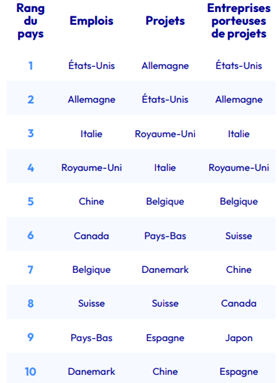
French business-law firm Simon Associés links Business France’s 2025 inbound-FDI report (1,878 investment decisions, 47,734 jobs) to the EU Inc proposal. The firm argues the new pan-European corporate structure — 48-hour digital incorporation, under €100, no minimum capital — will reshape how foreign investors set up in France.
Browne Jacobson's Irish corporate and M&A head William Darmody argues EU Inc is Europe's Delaware moment, highlighting incorporation costs under €100, no minimum capital, a harmonised stock option regime and a six-month simplified insolvency procedure as the proposal's most important features. He cautions that implementation detail will determine success.
eGov Hírlevél summarizes the Commission's EU Inc. proposal for a Hungarian public-administration audience, framing it as a response to the EU's fragmented landscape of 27 national systems and 60+ company forms. The piece highlights that founders could set up an EU-wide company within 48 hours for under €100, fully digitally, with the aim of boosting EU competitiveness and supporting innovative scale-ups.
The European Office of Cyprus summarises the Commission's EU Inc. proposal as an optional digital corporate framework that lets entrepreneurs set up a company in 48 hours for under EUR 100. It highlights unified tax identification, simplified cross-border investment, employee stock options and streamlined insolvency, while national employment protections are preserved.
FH warns that the Commission's 28th-regime / EU Inc. proposal, presented on 18 March, could let companies register in member states with weaker labour protection and apply those rules to staff working in Denmark. The piece focuses on Article 4(2) and the risk of undermining Danish collective agreements.
Spanish business outlet Merca2 explains how EU Inc creates a voluntary unified corporate identity valid across all member states, eliminating the need for separate legal structures per country. The piece frames the initiative as Europe's response to its competitive lag against the US and China and details its practical effects on hiring and commercial contracts.
Federnotizie, the publication of Italian notaries, analyses how the EU Inc. proposal (COM(2026) 321) would let companies be set up entirely online via the BRIS system without mandatory notarial involvement. The piece argues this directly challenges Italian notaries' historical gatekeeping role in incorporations, by-law changes and share transfers.
Italian SME confederation Conflavoro reviews the EU Inc. proposal from the perspective of Italian small and medium businesses, welcoming the 48-hour, sub-100-euro digital incorporation but flagging the technical adaptation needed for the Business Register. The piece argues the framework complements rather than replaces existing Italian startup and innovative SME rules.
ITwiz reports the Commission's EU Inc. proposal and gathers initial reactions from the Polish VC and startup community. Investors call it 'the biggest single step toward European competitiveness in years' but warn that without one central EU register and unified court interpretation, 27 national courts will still create chaos in disputes and insolvencies.
Startup Poland argues the Commission's EU Inc. proposal falls short because it is implemented through 27 member-state systems rather than as a truly supranational legal form. Without a single capital market, standardized investment contracts, and predictable investor rights akin to Delaware, the advocacy group warns, ambitious Polish and European founders will keep incorporating in the US.
European Council conclusions endorse the 'One Europe, One Market' agenda and call on co-legislators to adopt the 28th regime corporate framework by end of 2026, on the basis of the Commission proposal of 18 March.
the28thregime.eu reports that on 19 March 2026 EU leaders endorsed the 28th regime within the One Europe, One Market agenda and set an end-2026 adoption deadline, elevating the 18 March Commission proposal to a high-level political priority while leaving the legal text unchanged.
WKO's online magazine Marie explains how EU Inc. – a proposed 28th regime – would let founders set up a company online within 48 hours without minimum capital, and stresses why this matters specifically for Austrian firms that have to internationalise early. The piece characterises EU Inc. as a useful first step toward less bureaucracy but notes that venture-capital access remains a separate, unsolved problem.
Big-Four firm EY Germany analysed the 18 March Commission proposal, summarising the 48-hour digital incorporation, the EUR 100 cost cap, the absence of minimum capital and the centralised EU registration system. EY highlights that national tax regimes remain untouched but harmonised employee-share-option rules and a post-taxed treatment at sale are introduced, with the Commission targeting adoption by end of 2026 and applicability around early 2028.
Greek legal news portal Lawspot provides a lawyer-oriented walk-through of the EU Inc proposal: 48-hour incorporation, sub-100-euro cost, no minimum capital, single submission of company information, fully digital lifecycle, simplified wind-down, and clarification that national labour and social law are not affected.
Lider covers the Commission's EU Inc. proposal as a unified pan-EU corporate framework, with 48-hour online incorporation under 100 euros and no minimum capital. The article frames the 28th regime as an optional tool to keep European startups from relocating to the US or Asia, with first registrations expected in 2027.
Bug.hr details the Commission's fully digital EU Inc. proposal, with 48-hour incorporation, sub-100-euro cost and no minimum capital requirement. The piece stresses that national labour law and worker protections remain in force, addressing concerns raised earlier by unions.
Startup Online walks through the Commission's published EU Inc. proposal: a digital-first, optional company form allowing setup within 48 hours and minimum-capital relief. The article also reports critical reactions from the original grassroots EU Inc. coalition, which argues the draft relies too much on national registries and courts instead of a fully centralized European framework.
An Irish Times editorial endorses EU Inc as a useful step that will help small companies incorporate across the bloc in 48 hours for €100, while arguing further reforms are still needed to close the competitiveness gap with the US.
McCann FitzGerald's venture capital team summarises the Commission's EU Inc proposal: an optional corporate vehicle with 48-hour digital incorporation, fees under €100 and unified EU-wide rules, while flagging that national employment and tax regimes remain in place.
Adnkronos's Eurofocus desk explains EU Inc. as an optional 28th regime sitting alongside the 27 national systems, with 48-hour digital incorporation, no minimum capital and harmonized governance, management and insolvency rules. The piece highlights the structural problem the proposal addresses: 27 corporate law systems and over 60 legal forms across the EU.
Žinių Radijas episode of 'Europos greitkeliu' devoted to EU Inc., aired the day after the Commission tabled the proposal. Host Aušra Jurgauskaitė discusses the 28th regime with Lithuania's Minister of Economy and Innovation Edvinas Grikšas and Marius Vaščega, head of the European Commission's Representation in Lithuania, examining concrete benefits for Lithuanian companies.
AccountantWeek reports the Dutch Startup Association's reaction to the Commission proposal: DSA chair Lucien Burm welcomes EU Inc. but argues it is not yet a true 28th regime because it leans too heavily on 27 national systems, the central register is not fully centralised, and disputes still default to national courts. The DSA urges Parliament, Council and The Hague to raise ambition in the negotiations.
Legal-news portal Prawo.pl details the European Commission's EU Inc. design: 48-hour online registration for under EUR 100, no minimum capital, flexible share issuance to deter hostile takeovers, and streamlined liquidation procedures. The piece links the proposal to Mario Draghi's competitiveness report and notes the Commission seeks Parliament and Council agreement by end of 2026.
The Polish National Chamber of Legal Advisers (KIRP) summarizes the EU Inc. proposal for its members: 48-hour digital registration via a single EU-level interface, online shareholder meetings, simplified insolvency, harmonized ESOP tax treatment, specialised courts, and protection of worker participation rights. The Commission is targeting legislative approval by end of 2026.
MamStartup details the Commission's 28th-regime announcement and how it lands with Polish founders. The piece highlights three core features — pan-EU digital registration, harmonized ESOPs, and standardized investment paperwork — and argues the framework could end the Series-A/B 'Delaware flip' that has drained Polish and other European scale-ups.
Advocacy campaign by eu/acc Romania collecting signatures from Romanian founders, startups and investors on a public declaration urging the President of Romania to back EU-INC at the 19-20 March 2026 European Council. The site frames EU-INC as Europe's answer to Delaware, a pan-European 28th-regime corporate form with digital incorporation, EU-ESOP and EU-FAST instruments.
Svenskt Näringsliv (Confederation of Swedish Enterprise) analyses the Commission's EU Inc. proposal one day after its launch. Authors Elias Skog and Maria Althin welcome the focus on regulatory simplification and improved conditions for scaleups, while cautioning that a 28th regime alone cannot solve internal-market fragmentation and that expectations need to remain realistic.
European Commission tables COM(2026) 321: a regulation establishing the EU Inc. corporate legal form, with 48-hour digital incorporation, EUR 100 maximum fee, and simplified insolvency. Communication 'Towards a 28th regime for EU companies' published the same day.
European Commission press release IP/26/614 announces the EU Inc. proposal as an optional, digital-by-default European corporate framework intended to incentivise companies to stay in Europe and encourage those who looked elsewhere to return.
DG GROW publishes its EU Inc. landing page summarising the new harmonised corporate legal regime, listing the legislative proposal, impact assessment, and factsheets.
the28thregime.eu reports that the European Commission launched the EU Inc. optional company framework on 18 March 2026, featuring 48-hour digital registration with a EUR 100 cost ceiling, harmonised corporate rules, and simplified cross-border operations.
Danish Entrepreneurs (Dansk Ivaerksaetter Forening) and Danish Tech Startups, partners of the EU Inc. coalition, publicly back the Commission's 18 March proposal as a step toward removing cross-border friction for Danish founders.
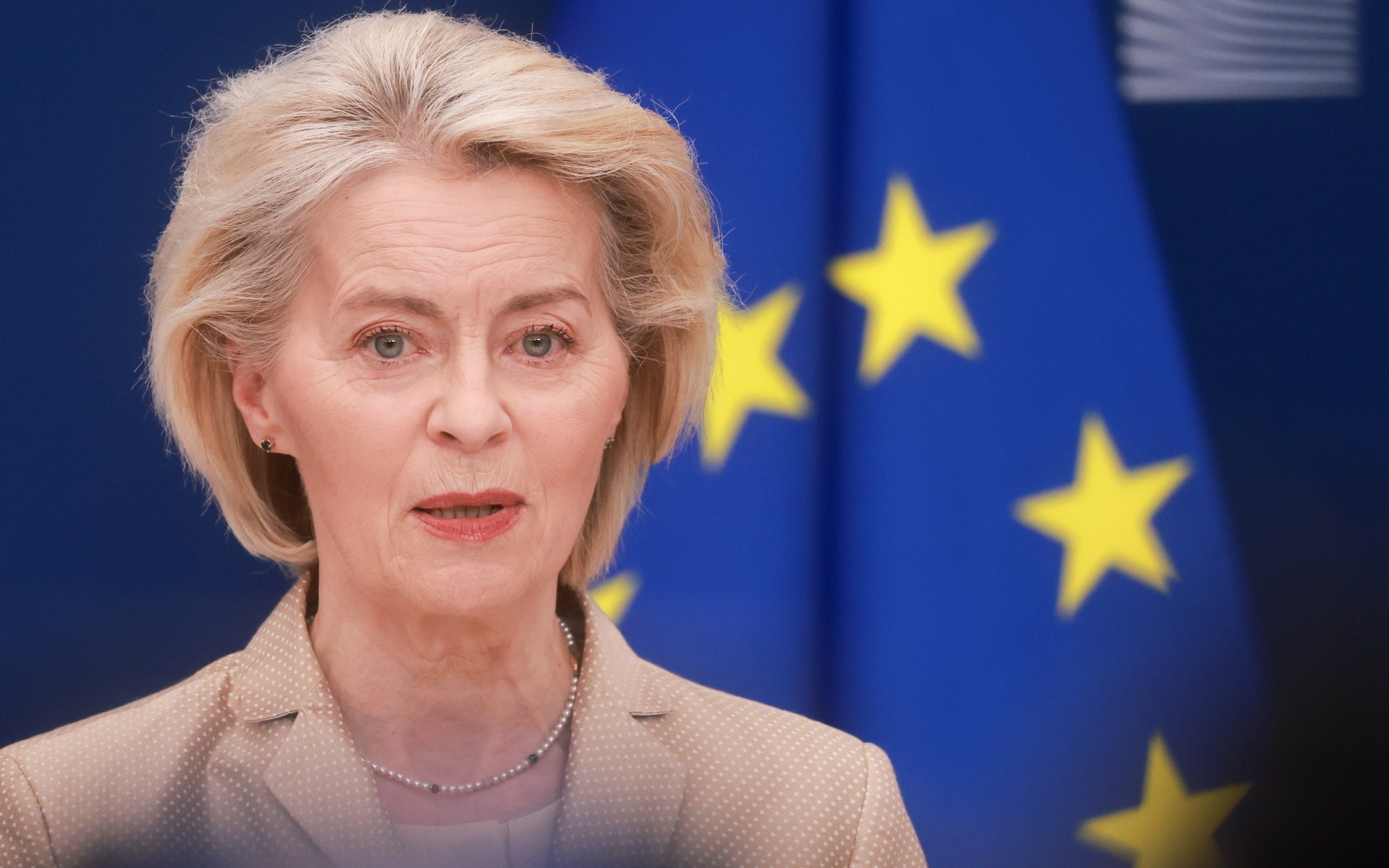
Austria's public broadcaster ORF reports on the European Commission's proposal, presented by President von der Leyen, for a new EU-wide corporate form called EU Inc. allowing fully digital incorporation within 48 hours for up to 100 euros. The article explains the proposal addresses fragmentation across more than 60 national corporate forms and notes that labour law of the country where work is performed will continue to apply.
Der Standard explains the European Commission's EU Inc. proposal and frames it as a response to Europe's competitiveness gap with the US and China, where European startups disproportionately fail to scale into billion-euro companies. Founding costs would be capped at 100 euros and the structure is designed to keep growing firms within the EU rather than seeing them relocate.
The Junge Wirtschaft, the young-business wing of Austria's Chamber of Commerce (WKO), publicly welcomes the EU Inc. proposal as an important step toward retaining founders and scaleups in Europe. The statement stresses, however, that regulatory simplification alone is insufficient and that access to venture capital remains the decisive bottleneck for European startups.
La Libre (Belgian French daily) reports on the Commission's launch of EU Inc., an optional 28th-regime company form intended to boost EU competitiveness against the US and Asia. The article frames the proposal around concerns about European unicorns relocating abroad and 27 fragmented national regimes.
Capital reports on the European Commission's 18 March 2026 EU Inc. proposal, explaining that new companies will be able to register across the EU within 48 hours for under 100 euros, with no minimum share capital and without trips to the notary. The piece frames EU Inc. as the long-awaited 28th regime that operates in parallel with the 27 national company laws.
Official Bulgarian-language press release from the European Commission Representation in Bulgaria announcing the EU Inc. proposal, an optional digital harmonised corporate framework available to all EU companies. It quotes Bulgarian Commissioner Ekaterina Zaharieva (Start-ups, Research and Innovation) saying EU Inc. will make doing business in the EU 'simpler, faster, cheaper'.
Economic.bg explains the EU Inc. / 28th regime package presented by the Commission, citing IMF figures that single-market barriers act like a 110% tariff on services and noting that 60+ different national company-law forms fragment the market. The piece flags expert concern that the proposed scope may be too broad and should be narrowed to innovative startups, with final adoption targeted for end-2026.
The European Commission's Representation in Cyprus relays the Commission's launch of EU Inc., an optional 28th corporate regime allowing harmonised EU-wide incorporation in 48 hours for under EUR 100 with no minimum capital. The framework introduces digital-by-default processes, EU-wide employee stock option plans and cross-border telework, addressing fragmentation from 27 national systems and 60+ company forms. The institutions are asked to reach agreement by end of 2026.
Czech public broadcaster CT24 reports on the European Commission's EU Inc. proposal unveiled in Brussels by Ursula von der Leyen, allowing entrepreneurs to set up a company within 48 hours, for under 100 euros, with no minimum capital. The piece explains the 28th regime as a new legal framework letting startups and fast-growing firms operate across the EU under unified rules.
Czech tech news site Lupa.cz covers the launch of EU Inc., a voluntary digital framework letting entrepreneurs incorporate fully online anywhere in the EU within 48 hours for under 100 euros. The article frames the proposal as an attempt to consolidate 27 national company-law regimes into a single European standard.
Czech law firm SEDLAKOVA LEGAL analyses the European Commission's EU Inc. proposal, walking Czech entrepreneurs through the 48-hour digital incorporation, sub-100 euro cost, and absence of minimum capital. The note frames EU Inc. as a response to fragmentation across 27 national company-law systems and to the trend of European startups relocating to the US.
The service-sector union ver.di sharply criticised the Commission's EU Inc. proposal on the day of its publication, with board member Christoph Meister calling it an obvious setback for worker rights. The union warns that the new legal form creates avenues to circumvent mandatory employee representation on supervisory boards and demands the German government restrict EU Inc. to startups and permanently anchor co-determination protections at EU level.
Legal news outlet beck-aktuell covered the Commission's same-day unveiling of EU Inc., laying out the 48-hour digital incorporation, EUR 100 cap and no-minimum-capital framework as a way to overcome Europe's 27 legal systems and 60+ corporate forms. The piece notes union concerns over the separation of operational and registered seat, with Justice Commissioner McGrath reassuring that employment law will follow place of work, not place of registration.
Ritzau-wire piece in Kristeligt Dagblad reports on the Commission's formal proposal for EU Inc., a single digital corporate framework letting founders register a company online in any EU member state within 48 hours. The article frames the proposal as a 28th regime designed to remove bureaucratic obstacles for entrepreneurs scaling across borders.
Danish business federation Dansk Erhverv welcomes the Commission's 28th-regime / EU Inc. proposal as a potential breakthrough for the single market, arguing it would cut costs and admin for SMEs and startups operating across borders. EU policy lead Andreas Geertsen calls an ambitious 28th regime a genuine opportunity for Denmark.
Estonian-language coverage of the European Commission's 18 March 2026 EU Inc legislative proposal: a voluntary, default-digital EU-wide company form designed to replace navigating 27 national systems and over 60 company types. Highlights include 48-hour online incorporation for under EUR 100, no minimum capital, EU-wide employee stock option plans, simplified tax registration and insolvency, with von der Leyen framing 2028 as the target for "one Europe, one market". The file now moves to Parliament and Council.
Spanish edition of Infobae reports on the European Commission's formal launch of the EU Inc proposal on 18 March 2026. The framework enables fully digital company incorporation in 48 hours for under 100 euros, remains optional, leaves labour and tax law to member states, and is projected to enable 300,000 new businesses over the next decade.
The European Commission's Finland Representation announces the formal EU Inc. proposal: a voluntary, fully digital pan-EU company form establishable in 48 hours for under 100 euros with no minimum capital. The Commission asks Parliament and Council to adopt the proposal by end of 2026.
Maddyness covers the European Commission’s 18 March 2026 proposal for EU Inc and gathers reactions from the French tech ecosystem. Maya Noël, CEO of France Digitale, calls it “a formidable opportunity” for the country’s innovation ecosystem, citing harmonized stock options and 48-hour digital incorporation as game-changers for French scale-ups.
Il Sole 24 Ore (Radiocor) reports on the European Commission's unveiling of EU Inc., an optional digital pan-European corporate framework serving as the 28th regime alongside the 27 national systems. The piece frames the initiative as a move to remove single-market barriers and curb capital flight to the United States.
Capital.gr covers the European Commission's formal EU Inc proposal, presented as the cornerstone of the 'Single Europe, Single Market' strategy. Reports the 48-hour online incorporation, no minimum capital requirement, and the optional digital regime that businesses can choose alongside national company forms.
HuffPost Greece reports that the Commission's EU Inc proposal aims to reduce Single Market fragmentation through a 'once-only' principle and uniform digital rules. The piece notes reservations over labour rights and the application of national rules within the new pan-EU form.
Index.hr reports on the Commission's formal proposal for the 28th regime, emphasizing 48-hour online incorporation, sub-100-euro cost and no minimum capital. The piece also flags the central EU register and a European business digital wallet planned by 2028.
Index reports that the Commission has formally unveiled EU Inc., the cornerstone of its 28th-regime competitiveness package. The optional, harmonized corporate form would allow registration in 48 hours for roughly €100 and is pitched as replacing today's 27 national rule-sets for startups and tech companies that want to scale across the single market.
The Budapest Chamber of Commerce and Industry (BKIK) summarizes the Commission's 28th-regime initiative for its members. It explains that the optional EU-wide legal framework would sit alongside national company law, ease cross-border operation for Hungarian businesses, and is intended to make it cheaper and faster for startups to scale and raise capital.
RTÉ reports on Irish EU Commissioner Michael McGrath's launch of EU Inc, a proposed pan-EU corporate framework allowing companies to be set up online within 48 hours under one digital legal regime. The piece frames it as a now-or-never moment for European competitiveness against the US and China.
The Irish Times covers Commissioner McGrath's EU Inc proposal, setting out pan-EU rules on company formation, insolvency and share option taxation. The article notes the scheme is designed to let businesses incorporate and wind down quickly and cheaply on an EU-wide basis.
Milano Finanza details the Commission's EU Inc. proposal, which would let entrepreneurs incorporate across Europe in 48 hours for under 100 euros via a single online process. The article frames it as a remedy to fragmentation across 27 national systems and over 60 corporate forms, aimed at retaining European startups.
Economyup walks through the 107-article draft regulation approved by the Commission introducing EU Inc., highlighting full digitalization, minimal capital requirements, ESOPs and streamlined insolvency. It also flags open questions on notary involvement and integration with Italian national law.
BNS-syndicated report on the European Commission's 18 March 2026 unveiling of EU Inc., a voluntary EU-wide legal framework that lets startups incorporate online within 48 hours, for under EUR 100, with no minimum share capital. The article frames the move as Europe's attempt to keep up with the US and China, quoting Ursula von der Leyen on simplifying cross-border business.
Paperjam reports on the European Commission's formal 18 March proposal for the 28th regime, allowing companies to be created EU-wide in under 48 hours with capped fees and digital-by-default procedures. The article notes tax treatment of EU Inc. companies will be handled separately.
Delano, Luxembourg's English-language business outlet, covers the European Commission's 18 March 2026 proposal launching EU Inc. as a single harmonised corporate framework. Companies could register in 48 hours for up to 100 euros via a digital interface, with a European Business Wallet handling cross-border filings throughout the company lifecycle.
Latvian-language republication of the European Commission Representation in Latvia's announcement that the EC presented its EU Inc. proposal on 18 March 2026. The article describes EU Inc. as the cornerstone of the EU '28th regime' — an optional, digital-by-default corporate framework meant to let companies start, operate and scale across all 27 member states under a single set of rules, instead of navigating 60+ national company forms.
The Dutch Senate (Eerste Kamer) opens its formal European dossier on the Commission's EU Inc. regulation proposal, citing Article 114 TFEU as legal basis. As of 24 March 2026 the Senate's Economic Affairs/Climate and Justice committees have accepted the dossier for examination and are awaiting the cabinet's BNC-fiche before delivering written input.
Bankier.pl reports on Ursula von der Leyen's unveiling of EU Inc., the so-called 28th legal regime. The proposal promises company registration in 48 hours, fully digital, for under EUR 100 with no minimum capital, a 'once only' data principle, and a European Business Wallet — while preserving existing worker rights including co-determination.
Rzeczpospolita's business desk reports on the Commission's official EU Inc. proposal — a 28th unified corporate regime allowing companies to be set up across Europe within 48 hours, entirely online, for under EUR 100, with no minimum capital. The piece frames it as a consolidation of 27 national legal systems and roughly 60 company forms into a single optional framework.
StartupCafe reports on the European Commission's official EU Inc. proposal published on 18 March 2026, an optional pan-EU 28th corporate regime allowing entrepreneurs to incorporate fully online in 48 hours for under EUR 100 with no minimum capital. The piece covers the proposed digital lifecycle, employee stock-option rules and single-market access, and links to the draft regulation.
Mediafax covers the Commission's EU Inc. proposal, summarising the 48-hour, under-EUR-100, fully-digital incorporation pathway, simplified insolvency and liquidation, EU-level employee stock-option plans, and free choice of member state of registration. The Commission targets political agreement by end of 2026.
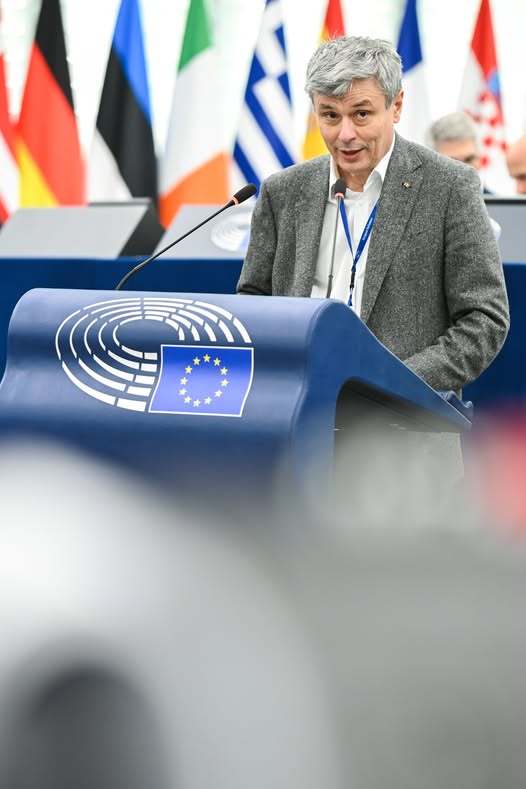
News.ro reports a statement by PNL MEP Virgil Popescu welcoming the Commission's EU Inc. proposal published the same day. Popescu recalls his January 2026 vote in the European Parliament for the 28th-regime resolution and stresses harmonised competitive conditions, digital procedures and ESOP rules taxed only on sale.
The European Commission's Representation in Romania publishes the official Romanian-language announcement of the EU Inc. proposal: a 28th, optional, harmonised corporate regime with 48-hour digital incorporation, EU-wide ESOP, takeover safeguards and a single tax identifier. The text outlines the next steps in Parliament and Council negotiations.
Företagarna (Swedish Federation of Business Owners), via Magnus Krantz, reports on the Commission's freshly-launched EU Inc. proposal. The article highlights the 48-hour registration target, sub-EUR 100 fees and removal of minimum capital requirements as a long-awaited response to the burden of 27 national company-law systems and over 60 different corporate forms.
Law firm Vinge, through partner Martin Johansson, publishes a legal analysis of the Commission's EU Inc. regulation issued on 18 March 2026. The piece walks through the harmonised digital incorporation within 48 hours, the EUR 100 fee cap and the absence of minimum capital requirements, and what these mean for cross-border operations.
Slovenian-language release from the European Commission Representation in Slovenia on the day of the EU Inc proposal. Frames EU Inc as an optional digital 28th-regime corporate framework cutting through 27 national systems and 60+ company forms, with adoption sought by end-2026.
Germany's digital industry association Bitkom and its president Ralf Wintergerst welcomed the Commission's forthcoming EU Inc. proposal as a real boost for Europe's startup ecosystem, citing survey data that 65% of German startups view an EU-wide legal form as an important promotion tool and 59% would prefer 24-hour registration. The statement frames EU Inc. as a way to simplify cross-border founding entirely digitally within 48 hours across all 27 member states.
The Confederation of Finnish Industries (EK) publishes a blog by Juho Maki-Lohiluoma and Hannu Ylanen previewing the Commission's voluntary EU-level company form. The authors argue a well-executed 28th regime could bring much-needed clarity and competitiveness to European corporate law by offering uniform structures across all member states.
Europske noviny reports Commissioner Michael McGrath's remarks on the EU Inc. proposal, framing it as the response to fragmentation across 27 corporate law systems. McGrath stresses the optional regime allows online registration within 48 hours with no minimum capital, standardised digital governance and harmonised insolvency, citing consultation results in which over 85% of respondents flagged divergent national company laws as a major barrier.
Opinion column by Jordi Rivera arguing that Europe's main bottleneck for building tech giants is legal fragmentation, not talent or capital. The author champions EU Inc / Regime 28 as the key instrument to unify rules on stock options, governance and capital, positioning Europe as a global innovation leader.
Justice Commissioner Michael McGrath argues in a Paperjam op-ed that EU Inc., the 28th corporate regime, will let entrepreneurs register fully online in 48 hours and operate under one set of rules rather than 27. The piece pitches the framework as a way to combine competitiveness, stability and equity for European startups.
StockWatch reports Deputy Minister Marilena Raouna briefing the European Parliament on the Cyprus Presidency's agenda, which explicitly includes promoting initiatives such as a 28th company law regime to facilitate cross-border activity and simplify rules so startups and SMEs can scale across the Single Market. The piece situates EU Inc. within the upcoming European Council discussion of the 'One Europe, One Market' competitiveness roadmap.
Infostart previews the EU Inc. proposal: a standardized entity that would let founders register a company online across any EU member state within 48 hours, with unified investment rules and EU-wide employee stock option schemes. The piece also notes that European trade unions have warned the framework could weaken worker protections.
LRT (via BNS) previews the upcoming EU Inc. proposal — described as the '28th regime' — and explains it as a voluntary digital company form designed to help European firms compete with US and Chinese rivals. The piece flags concerns from the European Trade Union Confederation that the regime could erode worker protections, comparing it to the unsuccessful 1988 European Company attempt.
Belgian digital-economy magazine Solutions Magazine publishes an opinion piece by Inetum Belgium GM Thomas Breuer. He argues EU Inc. shows Europe can simplify, but warns that fragmented data standards and 92% of European data sitting on US clouds leave the 28th regime's promise incomplete.
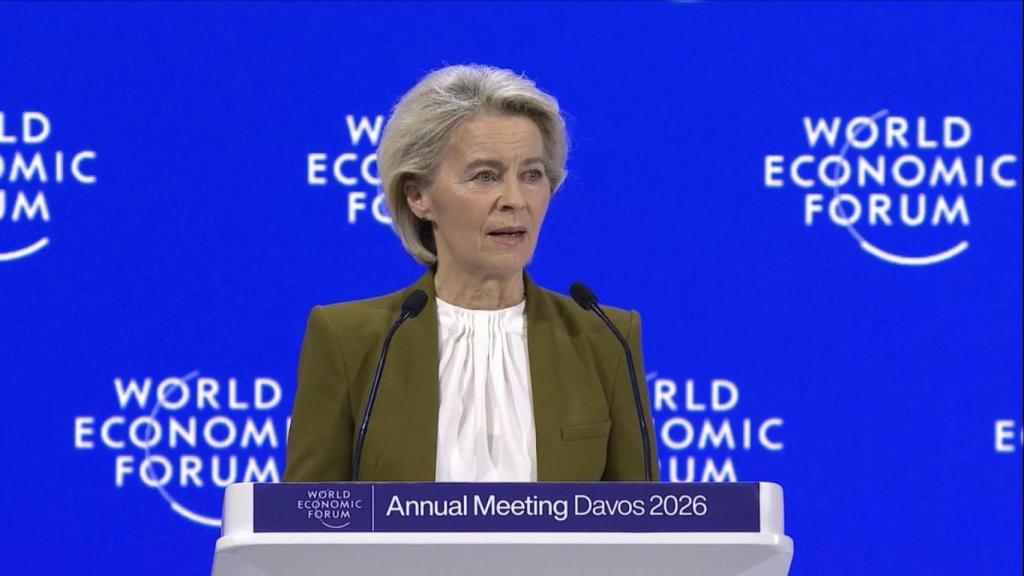
Telegram.ee publishes a critical opinion piece framing the EU Inc / 28th regime as a borderless corporate "superstate" pushed by startup elites and venture capital, citing Andreas Klinger (Prototype Capital) and von der Leyen's Davos remarks. The article warns that the framework could let companies opt out of national labour, tax and social-protection rules, presenting it as a democratic-oversight concern rather than a neutral business reform.
the28thregime.eu reports that the Commission has set 18 March 2026 as the EU Inc. proposal date ahead of the 19 to 20 March European Council, and frames the initiative within President von der Leyen's five-pillar One Europe, One Market plan covering administrative burden, the internal market, energy, digital infrastructure, and trade.
Greek business daily Naftemporiki reports (via Euractiv) on the EU's plan for a unified corporate regime for startups, focusing on the debate over the legal instrument – regulation vs. directive – and the political path toward adoption.
Spanish business magazine Emprendedores analyses how EU Inc / Regime 28 establishes a pan-European limited liability company recognised in all 27 member states via a fully digital 48-hour incorporation process. The piece highlights benefits for venture capital deals, stock-option harmonisation and reducing the incentive for European startups to flip to Delaware.
Vienna-based business outlet Trending Topics publishes an analysis by lawyers Philip Rosenauer and Nikolaus Pfau (PHH) arguing EU Inc. could deliver fully digital, 48-hour incorporation with standardised documentation. The authors warn, however, that the Societas Europaea (SE) largely failed because of complexity, and that EU Inc. must carefully balance founder flexibility against worker and creditor protections to avoid the same fate.
Latvijas Radio / LSM interview with Bruegel senior fellow Reinhilde Veugelers on Europe's innovation gap. Veugelers argues the 28th regime / 'EU Inc.' will be a crucial instrument letting innovative startups scale quickly across all EU markets, attract capital, and hire across borders — and notes Bruegel proposes calling it a 'zero regime' to future-proof the name if more states join the EU.
Cyprus law firm Michael Kyprianou (Amalia Avraam) walks Cyprus-based founders and investors through the proposed EU 28th regime / EU-INC. The note explains that EU Inc. would be an optional, digital-by-default alternative to the 60+ existing EU company forms rather than a replacement for Cyprus company law, and flags open questions on labour, tax and operational issues that local advisers will still need to manage during trilogue negotiations.
Ahead of the Commission’s 18 March proposal, this French tech-awards outlet previews the EU-INC framework that would let founders incorporate a pan-European company in 48 hours. The piece weighs the upside for French startups competing with US and Asian rivals against sovereignty concerns over national labour and tax law.
Iefimerida explains the EU Inc / 28th Regime proposal: a single optional pan-European corporate form allowing online incorporation in 48 hours, with no minimum capital. The article outlines how the framework would operate and its benefits for innovative companies.
The European Parliament's Subcommittee on Tax Matters holds a public hearing on the feasibility of a 28th tax regime alongside the forthcoming EU Inc. corporate proposal, with three expert groups recommending a narrow scope targeting equity, stock-option treatment, and administrative simplification rather than broad tax harmonisation.
the28thregime.eu reports that on 24 February 2026 the Parliament's tax subcommittee held a public hearing examining whether a 28th tax regime is viable alongside EU Inc., with experts converging on targeted equity treatment and administrative streamlining rather than broad harmonisation.
Spanish Economy Minister Carlos Cuerpo publicly champions uniform corporate rules through the E6 finance-minister grouping (DE, FR, IT, NL, PL, ES), naming the 28th regime among its competitiveness priorities.
Bloomberg TV Bulgaria interviews Alexander Nutsov, executive director of BESCO (Bulgarian Startup Association), who argues the EU's 28th regime could be more transformative for European entrepreneurship than the euro. He links the reform to needed pension-fund 'multi-fund' changes and tax incentives for angel investors and R&D so Bulgarian high-growth firms stop migrating to the US for capital.
Investor.bg's write-up of the BESCO executive director's interview. Nutsov calls for a unified EU corporate framework so companies can register and operate across all 27 states under one set of rules in minutes, and argues this is the single biggest lever for European competitiveness against the US, alongside tax incentives for R&D and angel investing.
Slovak law firm Hriadel-Heger & Partners explains the EU-Inc / 28th regime proposal as a voluntary alternative to national company forms (s.r.o., GmbH) rather than a replacement. The piece highlights digital-first registration via a central European registry within 48 hours and EU-wide recognition allowing operation across all member states without separate subsidiaries, while flagging concerns about employee protection and the political consensus still needed.
Infa.lt economics piece tied to the EU leaders' informal meeting at Alden Biesen Castle, framing the 28th regime as the Union's bet to stay competitive against US tariffs and Chinese green-tech subsidies. It explains that the voluntary regime would offer one EU-level set of rules on tax, labour, data protection and environment, with concrete legislation expected by early 2027.
Brussels-based French-language outlet 21News covers von der Leyen's announcement of the EU Inc. initiative, including the 48-hour digital incorporation, harmonised rules, easier financing and streamlined insolvency. The piece quotes her line that the Union must stop "functioning with the handbrake engaged."
Grant Thornton Sweden examines EU Inc. as a voluntary corporate structure designed to let startups and growth companies operate under unified rules across all EU member states. The article highlights how fragmented company law, unequal access to capital and complex employee stock-option rules have eroded European competitiveness against the US and China.
Forbes Slovenija analysis of the upcoming EU Inc / 28th regime proposal. Explains the 48-hour online registration, EUR 1 founding capital, and how a single pan-EU legal entity would let companies bypass the 27 national frameworks. Notes the Slovenian Technology Forum has urged PM Golob to back the initiative.
Bloomberg TV Bulgaria features Petar Ganev, senior researcher at the Institute for Market Economics (IME), explaining how the 28th regime would let companies register at EU level and bypass the 27 national systems. Ganev warns that Bulgaria is one of the member states most often obstructing the single market and cautions against narrowing the regime only to high-tech firms.
Investor.bg republishes IME economist Petar Ganev's analysis arguing the 28th regime is a chance for digital and innovative firms in peripheral markets like Bulgaria to scale 'at the size of the single market, not just nationally'. Ganev nonetheless cautions that overly narrow eligibility would blunt the regime's impact.
Greek startup outlet reports on the EU Inc / 28th Regime initiative and links it to Prime Minister Mitsotakis' commitment for Greece to be among the first adopters. Outlines the 48-hour digital incorporation, sub-100-euro cost, no minimum capital, and harmonised stock-option taxation that would apply when EU Inc enters force.
Matheson partners Emma Doherty and Pat English explain the proposed EU-Inc/28th regime: a pan-European private company structure allowing fully online incorporation within 48 hours and intended to replace the patchwork of national corporate laws that currently constrains cross-border scale-ups.
Der Standard's legal-affairs desk surveys the pre-proposal lobbying around EU Inc., describing how the Commission is preparing its draft while the European Parliament has floated competing ideas. The piece frames the contest as Europe's attempt to find an equivalent to Delaware-style standardisation across 27 fragmented national corporate-law systems.
StockWatch covers a Cyprus Forum panel in Brussels on financing EU competitiveness, where Google's Karen Massin called for a true '28th regime' and mutual recognition of contracts and procedures to unlock the Single Market, noting only around 10% of European SMEs export within the EU. Panellists from the Cyprus Presidency, SEV and CEPS framed the debate around the MFF and industrial strategy.
Lydian lawyers Maxime Colle, Wouter De Vos and Benjamin Louwaege review the EU Inc. blueprint announced at Davos. They compare it to the largely unused Societas Europaea and frame the 28th-regime initiative as a response to the Draghi competitiveness report.
Lydian's Maxime Colle, Wouter De Vos and Benjamin Louwaege publish the French version of their EU Inc. analysis for the Brussels legal community. They detail the 48-hour digital registration, harmonised governance, and the political hurdles of getting 27 member states to agree.
The Croatian Chamber of Trades and Crafts (HOK) lists the 28th regime among the headline EU files Croatian businesses should track in 2026-2027. HOK describes it as a non-binding uniform legal framework for cross-border EU operations, intended to ease scale-up and reduce legal fragmentation.
Executive Digest summarises the EU-INC (28th regime) announced by Ursula von der Leyen: a pan-European corporate framework allowing fully digital registration in 48 hours, uniform governance rules, standardised equity options, and simplified cross-border hiring. The article notes the Commission will present the legislative proposal in March 2026 with implementation targeted for 2027.
Antena 3 CNN reports on Commission President von der Leyen's Davos announcement of the EU-INC initiative and the upcoming March 2026 legislative proposal for a 28th corporate regime. The article situates EU Inc. as Europe's response to US Delaware-style fragmentation and notes the European Parliament's January vote (492 for / 144 against) endorsing the framework.
Powergame.gr reports on Ursula von der Leyen's Davos announcement of the 'Regime 28' / EU Inc framework and what it means specifically for Greek startups and scale-ups. The piece focuses on the operational impact in Greece of a single optional EU corporate form.
Malta Business Bureau CEO Mario Xuereb calls on the EU to apply 'insularity tests' when drafting directives so that single-market measures account for Malta's geographic constraints. He warns that horizontal EU frameworks, including coming corporate and competitiveness initiatives, can impose a 'tax on geography' on small island economies unless calibrated for Malta.
Danish law firm Hulgaard Advokater analyses the EU Inc proposal as a possible answer to the fragmentation of national company laws that holds back European startups. The piece walks Danish founders and investors through how a unified, digital, standardised EU corporate form could sit alongside the danish ApS/A/S and reduce cross-border friction for scale-ups.
Finance ministers of Germany, France, Italy, the Netherlands, Poland, and Spain announce the E6 group to push capital-markets, euro, defence, and supply-chain priorities, including the 28th regime, around EU political gridlock.
Rzeczpospolita columnist Katarzyna Kucharczyk welcomes the EU's announced 28th regime (EU Inc.), a unified European corporate form meant as an alternative to Polish Sp. z o.o. or German GmbH. She argues the framework could stop the exodus of European founders to Delaware, but warns that without safeguards it could be exploited for tax avoidance and weakened worker protections.
Dutch incorporation-services provider Firm24 explains the confirmed EU Inc. initiative to its entrepreneur audience, covering the 48-hour online registration, the central EU business register, standardised investment documents and unified employee stock-option treatment. The piece stresses that EU Inc. supplements rather than replaces the Dutch BV and that tax and labour law remain national competences.
the28thregime.eu reports that the European Parliament adopted recommendations supporting a unified 28th regime allowing startups to register digitally within 48 hours and operate across all EU Member States, with President von der Leyen confirming a Q1 2026 Commission proposal.
Spain's innovation ecosystem (EsTech-Adigital and business angels association AEBAN) welcomes the EU Inc / 28th Regime initiative as a major boost for cross-border startup activity. However, both organisations stress it must be adopted as a directly applicable regulation rather than a directive, or it risks adding bureaucracy rather than removing fragmentation.
The European Parliament has approved its negotiating mandate for the 28th regime / EU.inc, a new pan-EU corporate form intended to help startups scale across the single market. Danish MEP Kira Marie Peter Hansen was among the lead negotiators, and Denmark's trade union confederation FH stresses that the mandate keeps labour law as a national competence so Danish worker protections cannot be circumvented.
FrenchWeb reports on Ursula von der Leyen’s Davos announcement formalizing the EU-INC project and the optional pan-European 28th regime. The article cites Pascal Canfin and frames the framework as a sovereignty lever to close Europe’s 84% late-stage funding gap with the US and stop the exodus of French scale-ups.
Emerce reports on Commission President Von der Leyen's Davos announcement that the EU will create the EU Inc., a pan-European startup entity allowing 48-hour online incorporation under a uniform capital regime. The piece notes that first registrations are expected as early as 2028 and that the move responds to a petition signed by more than 20,000 European entrepreneurs.
Slo-Tech community thread tracking the EU Inc / 28th regime initiative from von der Leyen's January 2026 announcement. By March the thread author warns leaked details suggest the proposal is drifting toward 27 national implementations rather than a true 28th regime.
Bug.hr explains EU Inc. for a Croatian tech audience following the Davos announcement, walking through how the 28th regime would let startups incorporate once and scale across all 27 member states. The piece focuses on practical benefits for founders: standardized share options, faster registration, and reduced legal fragmentation.
SME Index reports on Slovak MEPs' reactions after the European Parliament adopted its 28th-regime recommendations (492-144-28). Ľudovít Ódor (PS) and Martin Hojsík (PS) welcome the proposal as a way to compete with the US and China and to keep startups in Slovakia. Branislav Ondruš (Hlas) objects that companies operating in Slovakia must remain subject to the Slovak Labour Code, warning the regime could erode national labour protections.
Plenary adopts the JURI legislative-initiative report (2025/2079(INL)) by Rene Repasi (S&D, DE), recommending the Commission propose a maximum-harmonisation framework based on Articles 50 and 114 TFEU, with strong employee-participation safeguards.
Netokracija reports on Ursula von der Leyen's Davos announcement of EU Inc., framing it directly for the Croatian startup audience: existing Croatian firms could operate cross-border under one unified set of rules without re-incorporating in every member state. The article describes the '28th regime' as an optional, digital-by-default corporate form.
France's Eric Lombard and Germany's Joerg Kukies meet to release a French-German Scale-Ups financing roadmap that includes explicit support for a successful outcome of the upcoming 28th regime negotiations on a new European corporate legal form.
Lider previews the upcoming 28th regime as a voluntary supranational legal framework that would let businesses incorporate under EU rules instead of national law. It highlights the 48-hour online setup promise but also flags concerns from trade unions and some member states about worker protections and tax competition.
Startup outlet Startitup interviews Slovak MEP Ľudovít Ódor (PS), Parliament rapporteur on tax aspects of the 28th regime. He frames it as the EU's effort to remove the last big barriers in the single market by letting firms opt into one harmonised ruleset instead of navigating 27 national rulebooks, with particular benefits for SMEs and faster cross-border expansion.
Startupbusiness's year-end review on the Italian startup ecosystem cites the EU's 28th regime / EU-Inc as a fundamental element for European competitiveness, urging that it arrive as a regulation rather than a directive. The piece captures sector advocacy in the run-up to the Commission's March 2026 proposal.
Slovak free-market think tank INESS publishes a position paper on the planned 28th regime, recognising benefits (digital registration, lower entry barriers, easier cross-border operations, pressure on member states to modernise) but warning of major implementation risks: unclear tax treatment, ambiguous labour-law applicability, uncertain access to state aid, legal uncertainty around dispute resolution, and the risk of low uptake if the regime is not actually simpler than national forms.
Euronews Portugal frames the 28th regime as a 'virtual 28th State' on the back of Startup Portugal's 2025 report (5,091 active startups, EUR 2.856 billion in revenue, around 1% of GDP). Alexandre Santos, president of Startup Portugal, argues that the new framework would let Portuguese startups operate seamlessly in every EU country regardless of where they were incorporated.
European Parliament President and Maltese MEP Roberta Metsola opened SiGMA Central Europe in Rome by attacking fragmented EU regulation and calling for an optional 28th regime, a unified European framework that would simplify cross-border business operations. She framed it as part of a 'European Way' built on innovation rather than over-regulation.
Lovin Malta reports on European Parliament President Roberta Metsola's SiGMA Rome keynote, where she floated the idea of an optional '28th regime' as a single EU framework to make cross-border scaling easier for companies ready to go big. She called out the EU's regulatory maze and divergent licensing rules as a brake on innovation.
COM(2025) 870 lists the 28th regime corporate legal framework among the Commission's 2026 legislative deliverables under the Single Market and Competitiveness pillar.
Lente.lv preview of the Commission's 2026 work programme highlights the upcoming '28. regulējums' (28th regime) as one of the most interesting new legislative initiatives — a voluntary, harmonised EU legal framework meant to make it easier for innovative companies to launch and operate across all member states. The piece frames it as a 'safety net' for startups under the Single Market Roadmap to 2028.
Startup Portugal publishes its response to the European Commission's public consultation on the 28th Regime, advocating for an optional harmonised corporate form with symbolic minimum capital, flexible shareholder rules, and standardised treatment of SAFE agreements and stock options. It calls for centralised, digital, bilingual registry procedures coordinated by a dedicated European administrative body.
Index.hu argues Europe's fragmented company law has pushed its top startups to incorporate in the US, UK or Switzerland, costing the continent capital and talent. The EU Inc. initiative would create an optional 28th regime — a standardized, digitally registered legal entity valid across all member states — to keep founders, money and innovation inside Europe.
Innotrepp reports that the Estonian government has finalised national positions on the EU's proposed 28th regime, backing creation of a new pan-EU company form provided it relies on e-solutions and rapid digital procedures rather than adding administrative burden. Estonia urges using the flexible features of the Estonian private limited company (no minimum capital, standardised articles, fast incorporation) as a template, supports a unified EU business register and wider e-identity use, and warns against rules such as asset-locking or mandatory sustainability governance that would deter founders.
The Dutch government files a non-paper with the Commission arguing that any new European corporate legal framework should be trustworthy, reliable, flexible, and practically workable, and that an effective 28th regime requires accompanying harmonisation of insolvency law and adjacent fields.
Watchdog Corporate Europe Observatory publishes a report arguing the EU 28th regime could let corporations bypass member-state worker-participation rules, echoing German trade union concerns about Mitbestimmung erosion.
Liina Vahtras, managing director of Estonia's e-Residency programme, argues in a Tech.eu interview that EU Inc. and the 28th regime 'should adopt the same digital-first approach' Estonia has built over two decades.
France and Germany publish a joint economic agenda whose Single Market and Simplification pillar commits both governments to introducing a 28th regime and a favourable regime for young innovative companies, while pledging to protect national labour and social standards.
The German Trade Union Confederation (DGB) states that, like the European Company (SE) before it, a 28th regime 'carries a significant risk of enabling companies to circumvent national co-determination laws' through strategic registered-office choice.
The Slovak Ministry of Justice calls on Slovak businesses to participate in the European Commission's public consultation (deadline 30 September 2025) on the proposed 28th regime, described as a new voluntary harmonised legal framework covering corporate, labour, tax and insolvency rules for cross-border EU companies. The ministry provides an unofficial Slovak translation of the consultation questionnaire.
Bulgarian law firm Ivanova Legal Solutions publishes a practitioner explainer on the 28th regime during the Commission's public consultation (8 July - 30 September 2025). It compares the proposed digital-first EU company form to existing Bulgarian forms (OOD, AD, DPK) and flags open questions on what counts as an 'innovative company' and how tax and labour rules will apply.
Ireland's Department of Enterprise, Tourism and Employment publishes a notice directing Irish stakeholders to the Commission's call for evidence on a '28th regime, a single harmonised set of rules for innovative companies', deadline 30 September 2025.
DG GROW launches a 12-week public consultation on a '28th regime, a single harmonised set of rules for innovative companies throughout the EU'. Deadline: 30 September 2025.
Tech2Business explains the EU's 'Open for Startups & Scaleups' strategy and describes the 28th European regime as an optional, harmonised framework that would let companies operate fluidly across the single market by transcending fragmented national legislation. The article outlines the five strategic pillars and the 2027 accountability reporting timeline.
Greek government digital agency portal DigiGov (operated under GRNET/EDYTE) explains the planned 28th legal regime for EU startups and scale-ups, covering corporate, tax, labour and insolvency dimensions. Frames the initiative as complementary to the Letta and Draghi reports and the upcoming EU Startup Strategy.
ECO gathers reactions from Portuguese VCs and founders to Brussels' Startup and Scaleup Strategy, with the 28th regime singled out as the pillar most expected to remove cross-border friction. Stakeholders warn that competitors like the UAE and Qatar are moving faster, making rapid implementation more important than the announcement itself.
Opinion piece by António Dias Martins, executive director of Startup Portugal, arguing that a 'truly supranational European regime' — the 28th regime — could make the difference between surviving and scaling for EU startups. He frames it as essential infrastructure so founders no longer need to adapt to 27 distinct national legal systems.
Commission publishes 'Choose Europe to Start and Scale', a five-pillar strategy that explicitly references the forthcoming 28th regime as the corporate-law backbone for cross-border scaling.
Jornal de Negócios reports on the European Commission's new Startup and Scaleup Strategy unveiled in May 2025, which commits to simplifying the regulatory environment via a new '28th European regime' to reduce costs and risks associated with cross-border operation. The piece outlines the strategy's other pillars: a European Business Wallet, the Scaleup Europe Fund, the Lab to Unicorn programme, and the Blue Carpet talent initiative.
Slovenian-language coverage (via STA) of the Commission's Startup and Scaleup Strategy. Confirms Brussels will table the 28th legislative-regime proposal in Q1 2026, allowing pan-EU company formation in as little as 48 hours, alongside the European Business Wallet and EIC expansion.
In an interview, Startup Hungary executive director Csongor Biás argues the single most important reform for European founders is a pan-European legal entity for startups, modeled on Delaware's C Corp. He says the Commission is receptive to the EU Inc. concept but the real political battle will be winning over member states.
Croatia's official EU funds portal reports that the European Commission opened a public consultation feeding the upcoming startup and scale-up strategy. The piece explicitly flags that the strategy will lead to a new EU-level legal status known as the '28th regime', framed as the Competitiveness Compass's flagship measure.
Fondation Jean-Jaurès publishes an analytical note dissecting Ursula von der Leyen’s push for a European business-law code. The authors probe three open questions: the regulatory vehicle, the tax implications and the social/labour standards that the 28th regime would impose on workers.
Helsinki Times covers the EU Inc petition crossing 15,000 signatures, with Finnish founders Ilkka Paananen (Supercell), Miki Kuusi (Wolt) and Aino Bergius (Slush) among the lead supporters. The article frames EU Inc as a response to Europe's funding gap versus the US and quotes Ursula von der Leyen on dismantling national barriers.
Commissioner Michael McGrath unveiled a first directive digitising EU corporate-law procedures, presented as the opening block of the long-awaited 28th regime first floated in 2009. Paperjam highlights an estimated 400 million euros in annual savings and the goal of letting innovative companies 'think EU' from day one.
Yle reports that more than 13,000 tech-sector signatories now back the EU Inc petition, which would let startups operate under unified pan-EU rules instead of 27 national tax and labour regimes. Supercell co-founder Ilkka Paananen is one of the earliest Finnish backers, alongside Wolt's Miki Kuusi and Slush CEO Aino Bergius.
COM(2025) 30 final, the 'Competitiveness Compass', sets out the EU's economic agenda for 2025-2029 and announces the creation of a 28th legal regime (named EU Inc.) to provide a single set of rules across the single market.
Paperjam covers the von der Leyen / Sejourne Competitiveness Compass, which formally puts the 28th regime on the EU's agenda alongside a simplification shock and an industrial energy-price plan. The optional regime is pitched as letting SMEs operate under one harmonised rulebook instead of 27 national systems.
Commission President Ursula von der Leyen tells the World Economic Forum that the EU will create 'a new truly European company structure', confirming political endorsement of the 28th regime concept ahead of the Competitiveness Compass.
EU Inc. organisers publish a detailed blueprint covering a standardised company structure, fully digital registry, an EU-FAST investment instrument, and an EU-wide ESOP, and call for the proposal's inclusion in the Commission's 2025 Work Programme. Petition counted over 13,000 signatures.
Von der Leyen II Commission takes office. Executive Vice-President Stephane Sejourne (Prosperity and Industrial Strategy) and Commissioner Michael McGrath (Democracy, Justice, Rule of Law) hold portfolios covering the 28th regime, per their September 2024 mission letters.
France Digitale and a coalition of European startup associations are mobilizing behind the EU Inc petition (10,000+ signatories) to lobby Brussels for a single pan-European corporate status. The article frames the 28th regime as essential to break market-fragmentation barriers that drive scaling French startups to the US.
France Digitale and around twenty European startup associations publish a position paper translating Ursula von der Leyen’s political ambition into concrete proposals for a 28th regime. The document echoes the Letta and Draghi competitiveness reports and calls for harmonized incorporation, employee stock options and public-procurement access for innovative companies.
Andreas Klinger (Prototype Capital) and Simon Schaefer (Factory) launch the EU Inc. petition with backing from Stripe, Wise, Supercell, DeepL, Wolt, Bolt, and dozens of European investors, calling for a 28th-regime startup entity.
French startup association France Digitale publishes a position calling for a 28th European regime, joining the EU Inc. coalition and citing the 70 percent of European scale-ups that export to the US first.
France's nominee for the new Commission, Stephane Sejourne, is designated Executive Vice-President for Prosperity and Industrial Strategy. The portfolio's mission letter from von der Leyen explicitly covers a 28th legal regime for innovative companies.
Mario Draghi presents 'The future of European competitiveness' to Commission President von der Leyen, recommending a 28th legal regime so innovative companies can scale across the single market under a single rulebook.
Former Italian PM Enrico Letta presents 'Much more than a market' to the European Council, proposing a European Business Code that would operate as an optional 28th regime alongside the 27 national company-law systems.